.png)
Alopecia Series, Part 1: What Exactly is Alopecia Areata?
- Jennifer Costello
- Nov 7, 2023
- 4 min read

Updated: Nov 9, 2023
For many people, "alopecia" wasn't a well-known term until the infamous slap. Jada Pinkett Smith has made this condition almost fashionable since she started publicly sharing her journey with alopecia in 2018 and beyond.
In this alopecia series, I aim to explain what alopecia areata is, some potential causes, nutrient recommendations, the importance of good nutrition, my own personal journey with alopecia, and some helpful reframes and other tools to help you cope.
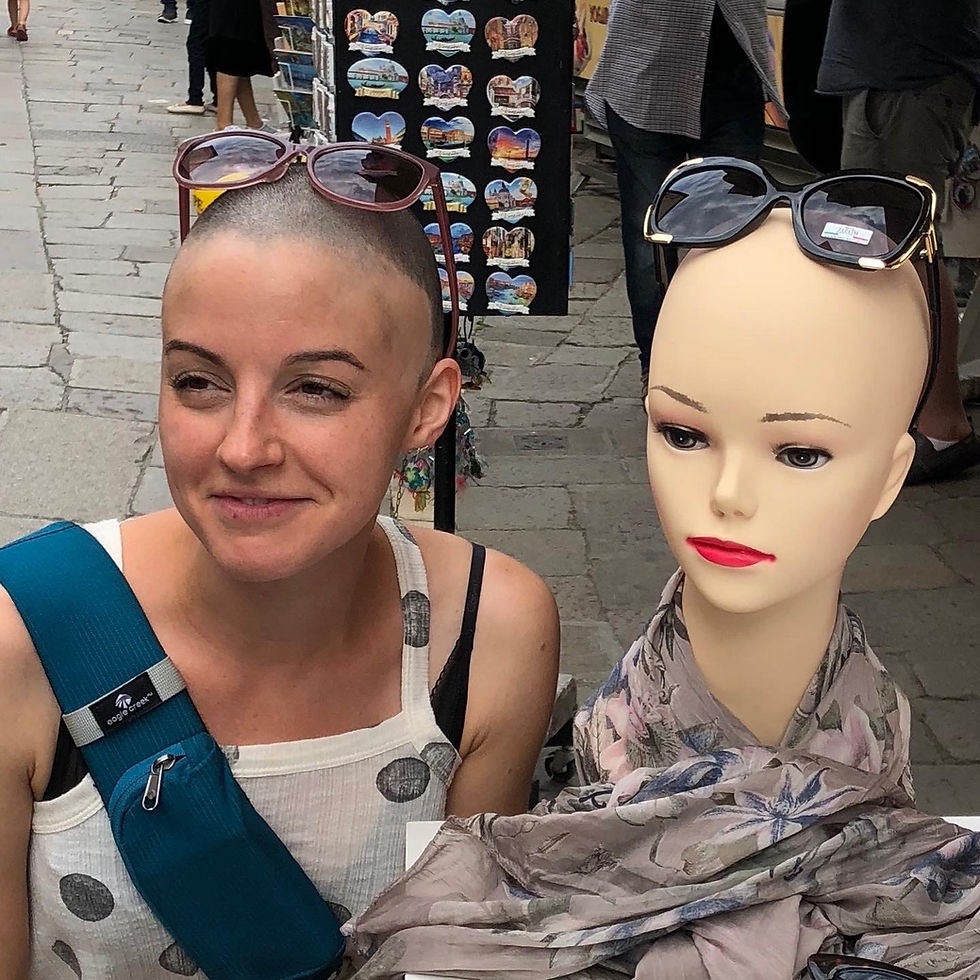
Photo cred to my friend Rebecca, who snapped this on our trip to Italy in 2018. At this point, most of my hair was regrowing, but you can see the sides where it was still bald. I couldn't resist getting a photo with this mannequin. I also felt like no one cared when I was in Italy - no one gave me a second look - while at home, I wore a headscarf everyday.
So, what exactly is alopecia areata?
Simply put, alopecia areata (AA) is an autoimmune condition that affects the hair follicles. Basically, hair falls out leaving behind a smooth bald patch in the shape of a circle or oval. Some people report having scars in areas of hair loss, but this isn't as common. It can affect the scalp and face, as well as any area of the body. It can start and stop at any point, but the hair loss is sometimes permanent. With autoimmunity, the body's immune system identifies a specific tissue as "dangerous", and takes steps to destroy the tissue. With alopecia areata, this is hair. The body mistakenly thinks that the hair is an invader, like a virus or bacterial pathogen, and attacks the hair follicles.
Interestingly, skin biopsies of AA patients show collections of natural killer cells, and Th1 cells, at the site of the hair loss (1). These cells are part of the body's immune system, and they do exactly what they sound like: kill the invading cells, such as from a virus or bacteria.
Most the time, the hair follicles are left undestroyed, meaning there is potential for the hair to regrow. This could take months or years, and is not guaranteed. As you can imagine, this condition can be extremely frustrating and emotional. Mental health is a huge focus for people struggling with alopecia, because it is so out of their control, and so difficult to hide depending on how far it has progressed. AA can progress to a more severe form of alopecia such as alopecia totalis (meaning the entire scalp is bald), or alopecia universalis (the entire body is affected). Again, in some cases, the hair never regrows.
Some people experience different sensations during a flare of alopecia areata. This could include stinging, itching, or general soreness. Most of the time, it is painless.
This condition affects both men and women, as well as children - it has no favourites. In my research, I could also not find any mention of specific races being more impacted by this condition.
There are other chronic conditions associated with alopecia, including eczema, asthma, inflammatory bowel disease, lupus, thyroid disease, and others (2). While correlation does not imply causation, it's interesting to note. I personally believe that autoimmunity does not target only one body system; if you have one autoimmune condition, there is great potential for you to develop more. This is why it's key to understanding your own personal triggers, and harness the power of nutrition and a balanced lifestyle to calm the immune system down.
Major Causative Factors
AA is an idiopathic condition, meaning it comes on quickly, sometimes spontaneously, and for which there is no known and accepted cause. One can develop it early in childhood, or have no hair loss at all until adulthood. It is unique to the individual.
There is still quite a bit of research being done in this area, but genetics are a possibility (3). Stress is another suspect for triggering a flare of alopecia, especially emotional and psychological stress. Other people I've spoken to report a big alopecia flare about 3 months after a major life event, such as a death in the family, divorce, having a baby, etc. This is anecdotal, but important to consider nonetheless.
Inflammation is a major causative factor being considered for AA. One paper I read looked at oxidative stress (i.e. the damage to your cells from toxins, etc) and suggested a possible link to alopecia areata as a cause (1). They also suggest a connection to the gut microbiome - the whole reason I recommend looking at nutrition for the management of AA!
Vitamin and mineral deficiencies are another interesting correlative factor. Specifically, iron, zinc, and vitamin D are being looked at as potential links (4), especially for women in the case of iron deficiency. Zinc and vitamin D are two extremely important nutrients for the health of the immune system, so a link would make sense here. A few researchers recommend supplementing with vitamin D for alopecia areata (5), as vitamin D helps to shift the immune system response from a pro-inflammatory response to a more anti-inflammatory one. Other than these three, no other vitamin and minerals have been directly linked to AA, its cause, prevention or treatment. I am of the opinion, however, that a nourished, happy body and mind are key to prevention and management.
In my next article, I'll focus on nourishing foods and appropriate diet for the management of AA, as well as discussing how inflammation is affected by our food choices.
Have you had an experience with AA? I'd love to read in the comments.
Sources (not in alphabetical order)
1. Pratt, C. H., King, L. E., Jr, Messenger, A. G., Christiano, A. M., & Sundberg, J. P. (2017). “Alopecia areata”. Nature reviews. Disease primers, 3, 17011 (Published online March 16, 2017). https://doi.org/10.1038/nrdp.2017.11. Accessed November 7, 2023.
2. Bolduc, C. (2020). “Alopecia Areata”. Medscape (Updated online August 6, 2020).
https://emedicine.medscape.com/article/1069931-overview#a6. Accessed November 7, 2023.
3. Żeberkiewicz, M., Rudnicka, L., & Malejczyk, J. (2020). “Immunology of alopecia areata”. Central-European journal of immunology, 45(3), 325–333 (Published online November 1, 2020). https://doi.org/10.5114/ceji.2020.101264. Accessed November 6, 2023.
4. Almohanna, H. M., Ahmed, A. A., Tsatalis, J. P., & Tosti, A. (2019). “The Role of Vitamins and Minerals in Hair Loss: A Review”. Dermatology and therapy, 9 (1), p. 51–70 (Published online December 13, 2018). https://doi.org/10.1007/s13555-018-0278-6. Accessed November 6, 2023.
5. Gerkowicz, A., Chyl-Surdacka, K., Krasowska, D., & Chodorowska, G. (2017). “The Role of Vitamin D in Non-Scarring Alopecia”. International journal of molecular sciences, 18 (12).
https://doi.org/10.3390/ijms18122653. Accessed November 7, 2023.


Comments